AA Intergroup Representative Toronto: How to Serve
AA Toronto: How to Become an Intergroup Representative — A Trusted Servant, Not a Director
Understanding the role of an Intergroup Representative, the importance of group conscience, and what it really means to serve Alcoholics Anonymous.
Stepping Into Service Beyond the Home Group
Recently, I became the Intergroup Representative for A.A. Solution Seekers, stepping once again into service beyond my home group. It had been approximately 17 years since I last held this position while representing the Parkdale group, and returning to an Intergroup meeting after all that time gave me an opportunity to reflect on how much has changed, both in my understanding of service and in myself.
The principles of Alcoholics Anonymous have remained remarkably consistent over the years, even as the people carrying the message continue to grow and change. Without the guiding light of A.A., I might have remained unchanged as well. Thankfully, recovery has given me the opportunity to see things differently, especially when it comes to listening, participating in group conscience, and recognizing the difference between being of service and wanting to be in charge.
During that first meeting back, I was reminded of something from the Twelve Steps and Twelve Traditions: the distinction between an elder statesman and a bleeding deacon. It is a powerful reminder that experience in service does not automatically make us wise. What matters is whether that experience has taught us humility, patience, and a willingness to place principles before personalities.
That reflection became particularly relevant as the meeting unfolded.
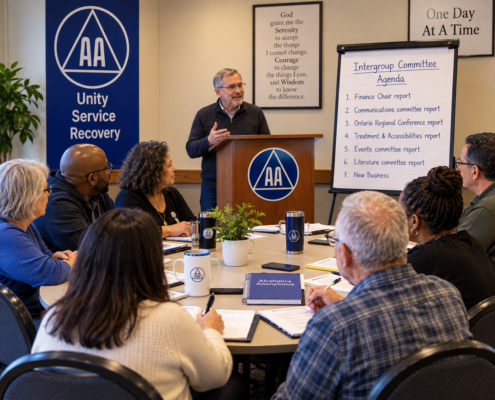
Intergroup reps at the operating committee level
What Does an Intergroup Representative Actually Do?
For A.A. members who have never attended an Intergroup meeting, the role of an Intergroup Representative may seem unfamiliar. Simply put, an Intergroup Representative helps connect their home group with the broader A.A. community and the services provided through Intergroup.
An Intergroup Representative attends meetings, learns about the activities and needs of the local A.A. service structure, participates in discussions and decisions, and brings relevant information back to their home group. Just as importantly, they carry the concerns, ideas, and group conscience of their home group into those discussions.
The position is not about authority over other members or groups. An Intergroup Representative is not a director, supervisor, or someone appointed to tell others how things should be done. The role is one of communication, participation, and responsibility, guided by the principle that our leaders are trusted servants rather than governors.
In practice, this means being prepared for meetings, understanding the concerns of the group we represent, listening carefully to other representatives, and recognizing that we are part of something larger than our individual opinions.
It also means understanding that service does not always unfold neatly or according to our expectations.
Learning to Listen When the Room Becomes Uncomfortable
At my first meeting back, a discussion arose concerning money and the Seventh Tradition. The operating chair had acknowledged at the beginning of the meeting that the matter was already under review, but later another Intergroup Representative brought the concern back to the floor. As the discussion continued, the atmosphere became noticeably tense.
Moments like these can reveal a great deal about how we approach service. It would be easy to focus on whether someone should have raised the issue again, whether the discussion was productive, or whether the meeting was moving efficiently. But I have learned that my first responsibility in those situations is not to take the inventory of everyone else in the room. It is to examine my own reactions.
Am I becoming impatient because the discussion is taking longer than I expected? Am I assuming that someone else’s concern is less important than my own? Am I listening with an open mind, or have I already decided what the outcome should be?
These are uncomfortable questions, particularly when our own ego can disguise itself as common sense, efficiency, or even concern for the fellowship.
The Seventh Tradition reminds us that financial responsibility and self-support are important principles in A.A. It is understandable that members may have strong feelings about how money is collected, managed, or used. Those concerns deserve thoughtful consideration, even when they are expressed in ways that challenge our patience.
The real test of service is not how we behave when everyone agrees. It is how we respond when someone sees things differently.
Understanding Group Conscience and the Right of Decision
One of the most important things a new Intergroup Representative can learn is the relationship between group conscience and personal responsibility.
We are entrusted to represent our home groups, but that does not mean arriving at every meeting with a fixed position that cannot be reconsidered. Discussions may reveal information that was not previously available, and other representatives may bring perspectives that help us better understand the issue.
Concept Three, which describes the Right of Decision, recognizes the importance of allowing trusted servants to exercise informed judgment within the responsibilities entrusted to them.
This is not permission to disregard the wishes of our home group or to pursue a personal agenda. Rather, it reminds us that responsible service requires participation, judgment, accountability, and a willingness to listen to the information presented.
A representative should understand the conscience of their group before attending a meeting whenever possible, while also remaining open to the discussions that take place. If an important issue requires further direction, bringing it back to the home group may be the most responsible course of action.
The purpose is not to win a debate or control a decision. It is to help ensure that decisions are made through an informed and thoughtful group conscience.
Why Every Voice Matters in A.A. Service
Concept Five offers another important lesson through the principles of minority opinion and the right of appeal.
In any service meeting, there will be occasions when someone disagrees with the majority or believes that an issue has not received sufficient attention. Their concerns may be difficult to hear, particularly when a meeting is running long or when others believe the matter has already been addressed.
However, the opportunity for minority voices to be heard is an important safeguard within A.A.’s service structure.
Sometimes the person raising an uncomfortable question is identifying something that deserves another look. At other times, the group may listen carefully and still decide to proceed in a different direction. Either way, respectful participation strengthens the process.
As an Intergroup Representative, I do not have to agree with every opinion expressed, but I do have a responsibility to remain respectful and open-minded. The question is not whether another member presents their concern perfectly. The question is whether I can respond according to A.A.’s principles, regardless of how the concern is presented.
This is where Tradition One becomes especially meaningful. Our common welfare comes first, and personal recovery depends upon A.A. unity. Yet unity does not require everyone to think alike, remain silent, or avoid difficult conversations. It requires us to work through differences without allowing those differences to divide us.
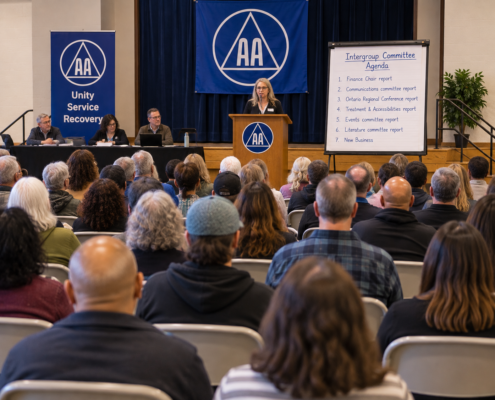
Intergroup reps meet
How to Become an Intergroup Representative in Toronto
For members interested in becoming involved in Intergroup service, the journey generally begins with their own home group. The representative serves as a connection between that group and the broader local A.A. service community, so the first step is to express an interest in the position and learn how the group selects its trusted servants.
A practical way to get started is to:
- Speak with your home group. Ask whether the group currently has an Intergroup Representative, whether the position is coming up for rotation, and what qualifications or expectations the group has established.
- Learn about Toronto Intergroup. Become familiar with the services, committees, activities, and responsibilities of the local Intergroup so you can understand how your participation helps support A.A. groups and members.
- Become familiar with A.A.’s service principles. Reading the Twelve Traditions, the Twelve Concepts for World Service, and A.A. service literature can help develop a better understanding of group conscience, trusted service, and the responsibilities of representation.
- Attend meetings and participate. Once selected by your group, attend Intergroup meetings regularly, listen to the discussions, ask questions when clarification is needed, and become familiar with the meeting procedures.
- Keep your home group informed. Report back on important discussions, upcoming activities, service opportunities, and matters requiring group input. Remember that communication must travel in both directions.
- Remain teachable. No one needs to arrive knowing everything about Intergroup service. Experience develops through participation, listening, asking questions, and learning from others who have served before us.
Individual groups and Intergroup bodies may have their own procedures and eligibility requirements, so it is important to confirm the current expectations with your home group and Toronto Intergroup.
Becoming an Elder Statesman Rather Than a Bleeding Deacon
One of the things I appreciate most about returning to Intergroup service after 17 years is the opportunity to recognize how my own understanding has changed.
There was a time when I might have believed that being effective meant having the strongest argument, knowing the procedures better than everyone else, or helping a meeting reach a conclusion as quickly as possible. Today, I am more interested in whether I can contribute without becoming attached to the outcome.
The distinction between an elder statesman and a bleeding deacon is not simply about how long someone has been around. It is about what we have learned from our experiences and whether those lessons have made us more useful to others.
An elder statesman can offer experience without demanding authority, share an opinion without insisting on agreement, and accept that a group may choose a different direction. A bleeding deacon, on the other hand, may struggle when influence diminishes, or when others do not follow the path they believe is best.
Most of us probably recognize a little of both tendencies in ourselves at different times. The important thing is to remain willing to grow.
When I feel myself becoming frustrated or impatient, I sometimes hear that familiar question: “How’s that little plan working for you?”
It is usually a good indication that I need to examine whether I am trying to serve the fellowship or manage the outcome.
Why Intergroup Service Matters to the Newcomer
It can be easy to become absorbed in meeting procedures, financial discussions, committee reports, and disagreements about how things should operate. These are legitimate parts of service, but they are not the reason Alcoholics Anonymous exists.
Ultimately, the purpose of our service efforts is to help ensure that the hand of A.A. remains available to the alcoholic who still suffers.
The newcomer walking into their first meeting may never know who attended an Intergroup meeting, who served on a committee, or who participated in a difficult discussion about the Seventh Tradition. Yet the services supported by those efforts can make a meaningful difference in whether that person finds a meeting, receives information, and discovers a community of people willing to help.
There are also newcomers to service who are watching how experienced members conduct themselves. They do not need to see perfect people or meetings without disagreement. What they need to see is that our principles are more than words we recite. They need to see humility, patience, respect, and a genuine willingness to put the welfare of the fellowship ahead of personal preference.
When we demonstrate those qualities, we help make service something that others want to participate in rather than something they feel intimidated by.
Trusted Servants, Not Directors
Returning to Intergroup has reminded me that service is not about having control, being recognized, or ensuring that everyone agrees with my understanding of what should happen. It is about being willing to participate in a process that is sometimes imperfect, occasionally uncomfortable, and always dependent upon the willingness of individual members to work together.
We bring our experience, our concerns, and the voice of our home group to the table. We listen to others, consider the principles that guide us, and trust the group conscience to do its work. Sometimes that means speaking up, sometimes it means asking a question, and sometimes it means accepting a decision that is different from the one we would have made ourselves.
After 17 years away from this particular service position, I am grateful to have another opportunity to learn these lessons. I may have more experience today than I did when I represented the Parkdale group, but experience only becomes valuable when it helps me serve with greater humility.
For anyone considering becoming an Intergroup Representative, I would encourage you to speak with your home group and explore the opportunity. You do not need to have all the answers or understand every aspect of A.A.’s service structure before getting involved. You need a willingness to learn, a commitment to communicate, and an understanding that the position is about responsibility rather than authority.
At the end of the day, the question worth asking ourselves is simple: Am I here to serve, or am I here to steer? For those that have found themselves on these committees for years, rotating from chair to chair, you may want to ask yourself “am I allowing new members to step up if I never step down?”.
Because Alcoholics Anonymous does not need more directors. It needs trusted servants who are willing to listen, participate, remain teachable, and do the work necessary to keep the doors open and the message available to the alcoholic who still suffers.
For more information about local A.A. service opportunities, visit AA Toronto or speak with your home group’s trusted servants.